Your care. Your choice. We will walk you through it.
This is your orientation to Missouri's Consumer Directed Services (CDS) program. You will learn what CDS is, what Caring Companions does for you, and how to hire, train and direct your own attendant with confidence.
8 short modules
Go at your own pace. Your place is saved automatically.
About 60 minutes
Stop whenever you need to and come back later.
Ends with a short check
Then you sign an acknowledgment and you are finished.
Questions at any point? Call Caring Companions at {{ phone }}. You never have to figure this out alone.
12 questions, then a short acknowledgment you sign with your name and the date.
{{ finalLockMsg }}
{{ vidEyebrow }}
{{ vidTitle }}
{{ sceneKicker }}
{{ sceneTitle }}
{{ l.t }}
{{ artCenter }}
{{ d.t }}
{{ artBig }}{{ artSmall }}
{{ artCaption }}
Your maximum
{{ artCaption }}
{{ artBig }}
{{ artCaption }}
{{ artBig }}
{{ artCaption }}
{{ artBig }}{{ artSmall }}{{ artCaption }}
{{ r.mark }}{{ r.t }}
{{ timeLabel }}{{ sceneCounter }}
Voiceover not found yet. Drop the recorded file at {{ audioSrc }} and it will play here automatically. The visuals are running on estimated timing for now.
{{ p.t }}
Module 1 of 8
Welcome to CDS
Consumer Directed Services, or CDS, is a Missouri Medicaid program that lets you stay in your own home and hire your own caregiver, called an attendant. You are in charge of your care.
The one thing that makes CDS different
With a traditional home care agency, the agency picks the caregiver, sets the schedule, and tells that caregiver what to do. In CDS, you do those things. You are the employer of your attendant, which means you are responsible for hiring, training, supervising and directing them.
Remember
CDS gives you more control over your care. That control also means you have real responsibilities as the consumer. This orientation teaches you exactly what they are.
Words you will hear
Consumer
You. A person the Missouri Department of Health and Senior Services (DHSS) has found eligible for CDS.
Attendant
The person you hire to help with your daily tasks. Your attendant is your employee, not an employee of Caring Companions, DHSS, or the state of Missouri.
Vendor
Caring Companions. We hold the agreement with DHSS to handle payroll, attendant screening, monitoring, and your training and support.
Plan of care
The document created from your DHSS assessment. It lists the tasks you are approved for, how often, and the maximum units of care you may use.
Unit of service
One unit equals 15 minutes of care.
Unmet needs
Daily tasks that cannot reasonably be met by people already in your household without causing undue hardship. CDS pays for unmet needs.
The kinds of help CDS can cover
Your plan of care may include routine tasks such as bowel and bladder needs, dressing and undressing, moving into and out of bed, preparing and eating food and drink, bathing and grooming, shopping and transportation, using aids and equipment, walking, and housekeeping.
Your own plan of care is the final word on which of these you are approved for.
Knowledge check
True or false: in CDS, Caring Companions decides who provides your care and how your tasks are done.
Correct. You choose, hire, train and direct your attendant. Caring Companions handles the vendor duties such as payroll, background screening and monitoring.
{{ fb_m1 }}
Module 2 of 8
Who does what
Three people share the work in CDS: you, your attendant, and Caring Companions. Here is the honest split.
You, the consumer
Choose and hire your attendant. Train them. Set the schedule. Supervise the work. Report changes. Keep your Medicaid active.
Your attendant
Show up as scheduled. Do only the tasks on your plan of care. Clock in and out accurately. Keep your information private.
Caring Companions
Payroll and taxes. Background screening. Medicaid billing. Monthly case management. Training and support for you.
What Caring Companions does for you
Collect your attendant's time, certify it, and pay your attendant on your behalf
Pay all payroll, employment and other taxes on time
File the Medicaid claims for your services
Keep a list of eligible attendants and screen them through the Family Care Safety Registry, the Employee Disqualification List, and the federal exclusion list
Train and orient you in the skills needed to recruit, employ, instruct, supervise and keep an attendant
Answer your questions and help with problems
Keep your records confidential
Check in with you at least monthly and monitor your use of authorized units
Make sure you have an emergency and backup plan
What Caring Companions does not do
We do not choose your attendant for you or send a substitute when yours cannot come
We do not set your schedule or tell your attendant how you like things done
We do not decide how many hours you get. DHSS does that through your assessment
We do not supply cleaning products, gloves, gas or a vehicle. Those are yours to provide
Your attendant is never our employee, so day to day direction comes from you
Call us
You do not have to figure everything out yourself. If you are unsure whether something is allowed, call us at {{ phone }} before you do it.
What would you do?
Your attendant calls at 7 a.m. and says they cannot come today. Who is responsible for finding a replacement?
Correct. You are the employer, so covering a call off is your responsibility. That is why consumers are strongly encouraged to hire a backup attendant in addition to a primary one. Call us if you are left without care and need help.
{{ fb_m2 }}
Module 3 of 8
Your responsibilities
These come straight from the CDS rules. None of them are hard on their own, and we will help with any of them.
Your plan of care
Your plan of care comes from an assessment done in your home by DHSS. It lists the maximum units of personal care you may use, which services you get and how often, when services start, and when you will be reassessed. You and DHSS both sign it, and you and Caring Companions each get a copy. Your needs are reassessed at least once a year.
What your care plan actually looks like
This is a real state care plan with all personal information replaced. Yours arrives in this same format.
Home and Community Based Services Care Plan
Sample only. Names, addresses and numbers have been replaced.
Participant
EXAMPLE CONSUMER
Physical address
123 Example Street, Apt 100 Springfield, MO 65800
Primary phone
(417) 555-0100
DCN
00000000
Date of birth
01/01/1970
Care plan period
08/04/2025 to 06/30/2026
Authorized service
Service type PC - CDS
Dates 08/04/2025 to 06/30/2026
Provider Caring Companions
Procedure code T1019
Authorized units by month
Month
Units
Hours
{{ pm.m }}
{{ pm.u }}
{{ pm.h }}
Units are 15 minutes each, so 243 units is about 60 hours for the month. Monthly totals differ because months differ in length.
Authorized tasks
Task
Minutes per day
Days per week
{{ pt.t }}
{{ pt.m }}
{{ pt.d }}
No two plans are the same
Here are two real plans side by side, both anonymized. Same program, same provider, different approvals, because each one came from a different assessment.
Example Consumer A
243 units in a full month, about 60 hours, or roughly 2 hours a day.
15 approved tasks including bathing 3 days a week, laundry off site, treatments daily, and essential transportation.
Example Consumer B
314 units in a full month, about 78 hours, or roughly 2 and a half hours a day.
15 approved tasks including bathing 7 days a week, laundry at home, making the bed daily, and essential correspondence.
Notice that B is approved for more time and for bathing every day, while A is approved for treatments and off site laundry that B is not. Your plan is yours. Do not compare your hours to a friend's and assume something is wrong.
How to read it
The task list is what your attendant may do. The monthly units are the most care that may be recorded that month. If something you need is not on the task list, call us before asking your attendant to do it.
Your ten responsibilities as the employer
Select, hire, train and supervise your attendant
Use the electronic time tracking system we designate to track your attendant's time worked
Make sure the time submitted never goes over the units authorized in your plan of care
Tell DHSS and Caring Companions within ten days about any change that affects your plan of care, including a move
Tell us promptly about any problem with the quality of your attendant's work. If we cannot resolve it together, it goes to DHSS
Keep your Medicaid status active, including meeting your spenddown each month if you have one
Train your attendant on how to complete the tasks authorized on your plan of care
Provide the supplies and equipment your attendant needs for authorized tasks, such as cleaning supplies, a vehicle and gas
Let your attendant and Caring Companions know if you will not be home for a scheduled shift
Tell Caring Companions when you are hospitalized
Remember
If you have a Medicaid spenddown, it must be met every month for your attendant to be paid. An inactive Medicaid status stops attendant pay.
Staying in the program
DHSS can reduce, deny or end CDS in certain situations, including when a consumer can no longer direct their own care, moves into a facility, falsifies records or commits fraud, is persistently noncompliant with the plan of care, or when a member of the household threatens or abuses the attendant or our staff.
If DHSS denies, reduces or ends your services, you get that decision in writing and you may request a hearing. Services continue during that period unless you ask in writing to stop them.
Knowledge check
Which of these is your responsibility as the consumer?
Correct. Supplies and equipment for authorized tasks are the consumer's responsibility. Attendants are not required to bring their own.
{{ fb_m3 }}
Module 4 of 8
Hiring your attendant
You get to choose. Often that is a family member, a friend or a neighbor. Here are the rules and some practical advice.
Who may work as your attendant
At least 18 years old
Able to meet the physical and mental demands of your tasks
Willing to keep your information confidential
Emotionally mature, dependable, and able to handle an emergency
Registered with the Family Care Safety Registry with a clear screening, or holding a Good Cause Waiver from DHSS in good standing
Not listed on the Employee Disqualification List or the federal List of Excluded Individuals and Entities
Stop
Your spouse may not be paid as your attendant. No one may begin working, or be paid, until Caring Companions has completed their screening and paperwork.
How many attendants
You may hire up to four attendants. That limit exists because of workers' compensation law. You are strongly encouraged to hire a primary attendant and at least one backup so you are covered when your primary attendant is unavailable.
You are an equal opportunity employer
As the employer you must select attendants without regard to race, color, national origin, sex, age, religion, political beliefs or disability. You may absolutely choose based on skills, reliability, availability and whether the person is a good fit for your needs.
Questions worth asking before you hire
Which days and hours can you truly commit to, every week?
Are you comfortable with personal care tasks such as bathing and toileting?
Do you have reliable transportation, and can you drive for errands if my plan includes them?
How will you let me know if you cannot come?
Do you have a smartphone for the WellSky app, or will you clock in from my home phone every shift?
Can you handle an emergency calmly and follow my instructions?
Knowledge check
Which person may not be paid as your attendant?
Correct. A consumer's spouse cannot be the paid attendant. Other family members and friends can be, as long as they pass screening.
{{ fb_m4 }}
Module 5 of 8
You are responsible for training your attendant
This is the part that surprises people, and it is also the best part. Nobody knows your routine, your home or your body like you do. Your attendant needs you to teach them.
Caring Companions will help you get ready and will assist with the general orientation of your attendant when you ask. What we cannot do is teach someone how you like your coffee, how you transfer out of bed, or which shirt goes with which day. That is your job, and it is what makes CDS care fit you.
How to train your attendant, step by step
1Show them how you like things done. Walk through a task together the first time instead of describing it.
2Review your care needs and your authorized tasks together, using your plan of care.
3Explain your normal routine: when you get up, when you eat, when you rest, what happens first.
4Show them where supplies are kept: linens, cleaning products, gloves, laundry, trash.
5Explain your mobility and safety needs: how you transfer, which side to stand on, what hurts, what helps.
6Talk about medications only as they relate to your routine and your approved tasks. Do not ask an attendant to do anything with medication that is not authorized on your plan of care.
7Set household expectations: shoes on or off, pets, phone use, visitors, quiet hours.
8Establish a written schedule that fits inside your authorized units.
9Explain call off expectations: how much notice you need, who to call, and what you will do for backup.
10Teach them the clock in and clock out process, and watch them do it the first few shifts.
11Make sure they understand they may never clock in when they are not actually providing your care.
12Correct problems early and kindly. A small habit fixed in week one does not become a crisis in month six.
13Call Caring Companions when you need help. Coaching you through attendant problems is part of our job.
Handling problems
Do
Say something the first time, not the tenth
Be specific: what happened, what you need instead
Keep your own simple notes of dates and issues
Call us promptly about quality problems
Use your backup attendant when you need to
Do not
Let unpaid time or extra hours be a favor you trade later
Ask for tasks that are not on your plan of care
Ask an attendant to care for other people, children or pets
Wait months and then expect a quick fix
Handle a safety concern alone
What would you do?
Your new attendant asks how you like to be helped in the shower. Who teaches them?
Correct. Training your attendant on your own needs and routines is your responsibility as the consumer, and we will support you while you do it.
{{ fb_m5 }}
Module 6 of 8
Hours, scheduling and clocking in
Two ideas make this whole section simple: authorized hours are a maximum, and recorded time must match the care that actually happened.
The state approves your units. Not us.
The Department of Health and Senior Services assesses you and approves a set number of units for each month, plus how much care each authorized task gets. That approval is printed on your care plan, month by month, the way you saw in module 3.
Caring Companions can only bill Medicaid for what the state approved, which means we can only pay your attendant for what the state approved. If your attendant works beyond your approved amount, there is no funding to pay them for it. That is not a policy choice on our end. It is the limit of the authorization.
Monthly total
Your care plan lists the units approved for each month. Short months are approved for fewer units.
Daily amount
Your attendant may only work the amount of time per day that your approved plan supports.
Your choice
You choose the time of day your services happen. Morning, evening, split up across the day, whatever fits your life.
We can do the math for you
If you would like help, just ask. We will take the tasks on your plan of care, spread them across the days, and tell you how many days per week and how many hours per day your approval supports.
Then the only decision left to you is the fun one: which days you want your attendant to come, and at what time.
A quick example using the sample plan from module 3. 243 units in a month is about 60 hours, which works out to roughly two hours a day. So that consumer would build a schedule with their attendant of about two hours per day, at the times of day they prefer, and stop there.
Remember
Missouri does not give everyone the same number of units. Your amount comes from your own assessment. State rules cap what can be authorized at a cost that does not exceed the average monthly Medicaid cost of nursing facility care.
If you believe you need more care than you were approved for, you can ask for an increase. Your needs are also reassessed at least once a year, and sooner if your condition changes.
Watching the hours is your job
You are responsible for making sure your attendant does not work more than your approved hours. Not us, and not your attendant. You are the employer, so tracking what has been used is part of the job.
Stop
If your attendant works more hours than the state approved, the units run out before the end of the month. Once they are gone, they are gone. Any hours worked past the authorized limit will not be paid.
That leaves you with no covered care for the rest of the month and your attendant working for free. Both of those are avoidable with simple tracking.
How to stay inside your hours
Divide your monthly units into a weekly plan and stick to it
Write down the hours worked each shift, in your own record
Check your running total against your monthly total every week
Adjust the schedule mid month if a week ran long
Call us if you cannot tell where you stand. We monitor your usage monthly and will help you check
Using your hours matters
Here is something consumers are often surprised by. If you regularly do not use the hours you were approved for, that can work against you. The state looks at what you actually use, so unused hours can make it harder for them to justify authorizing an increase later.
This is not a reason to record time that was not worked. It is a reason to schedule and actually use the care you need, and to speak up if your approval no longer matches your life.
How to ask for more hours
You may call the state directly and request an increase. Be ready to say three things:
Which tasks you need added to your plan of care
Which tasks you need more time for
Why, in plain terms. What changed, and what happens without the help
Call us first if you want help thinking it through or getting your examples together. We cannot approve hours, but we can help you prepare.
One more billing rule worth knowing: only one attendant may be on the clock providing your CDS at any given moment, because Medicaid allows one service code per participant at a time. Two attendants may not clock in for the same hour, even for different tasks.
Authorized hours are a ceiling, not a target
Your plan of care authorizes a maximum number of units, and one unit is 15 minutes. You may use up to that amount when care is actually provided. There is no requirement to use every unit, and unused time is never a reason to record care that did not happen.
Remember
Keeping your own simple record of your attendant's time is one of your responsibilities. It is how you catch a problem before payroll does.
The electronic time tracking system
Missouri requires every home and community based services vendor to use an electronic time tracking system. There are exactly two ways your attendant may clock in and out, and no others.
Option 1 · Most attendants
The WellSky Personal Care app
Your attendant needs a smartphone that can download the app. They clock in and out in the app at the start and end of every shift. This is how most attendants clock in.
Option 2
A call from your home phone
Your attendant calls the telephony line at 844-899-7686 from your home telephone, the number registered to your residence or in your name, and enters their telephony PIN.
Stop
Clocking in by calling from a cell phone does not work and is not allowed. It is the app, or your home phone. Nothing else.
The telephony PIN
Every attendant is assigned their own unique 8-digit telephony PIN, which they enter when clocking in from your home phone. If your attendant will use your home phone, call Caring Companions at {{ phone }} and ask for your attendant's telephony PIN, then pass it to them. The PIN identifies your attendant personally, so it is theirs alone: never let anyone else clock in with it.
If you use the home phone option, you will sign a form authorizing that number to be used for attendant time tracking. Talk about this before you hire someone: if your attendant does not have a smartphone that can run the app, you need a working home telephone.
Your part
Keep your home phone available, or confirm your attendant can use the app
Make sure your attendant uses the system every shift
Keep your own separate record of time worked
Compare that record against your authorized hours
Make sure the time recorded with us is correct
Your attendant's part
Clock in on the app, or from your home phone, before starting work
Clock out the same way immediately when the work is done
Report the tasks actually completed
Verify their recorded times daily
Keep their own backup record of time worked
No paper timesheets
Caring Companions does not use paper timesheets at all. Every shift is recorded electronically, in the app or from your home phone. There is no paper slip to fall back on, which is exactly why the clock in and clock out habit matters so much.
When a clock in or clock out is missed
Stop
Never fix a missed punch by recording time that was not worked, by adding the time onto another day, or by having your attendant stay clocked in while care is not being provided. That is falsification.
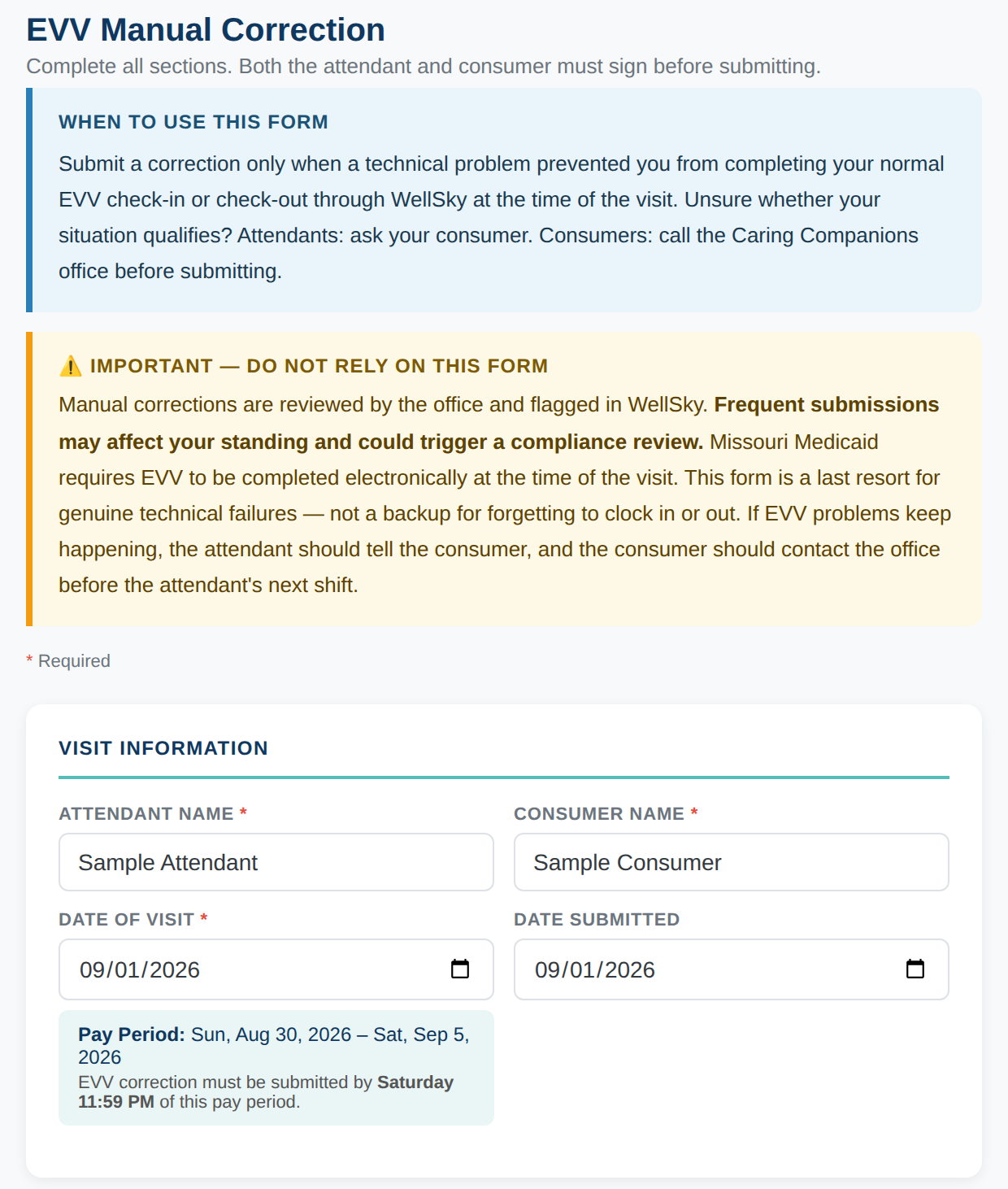
When a genuine technical problem stops the clock in or clock out, there is one correct path: the online EVV Manual Correction Form.
The EVV Manual Correction Form
Fill it in online at hub.caringcds.com/evv-form, together with your attendant, and submit it by 11:59 PM Saturday of that pay period.
Tell your attendant to save the form to their phone's home screen, so it is one tap when they need it.
How to fill out the correction form, step by step
Step 1 — Names and dates
The two notice boxes at the top explain when the form may be used: only when a genuine technical problem prevented a normal clock in or clock out. Below them, enter your attendant's full name, your full name, and the date of the visit being corrected. Picking the visit date shows the pay period and the exact Saturday 11:59 PM deadline for that visit.
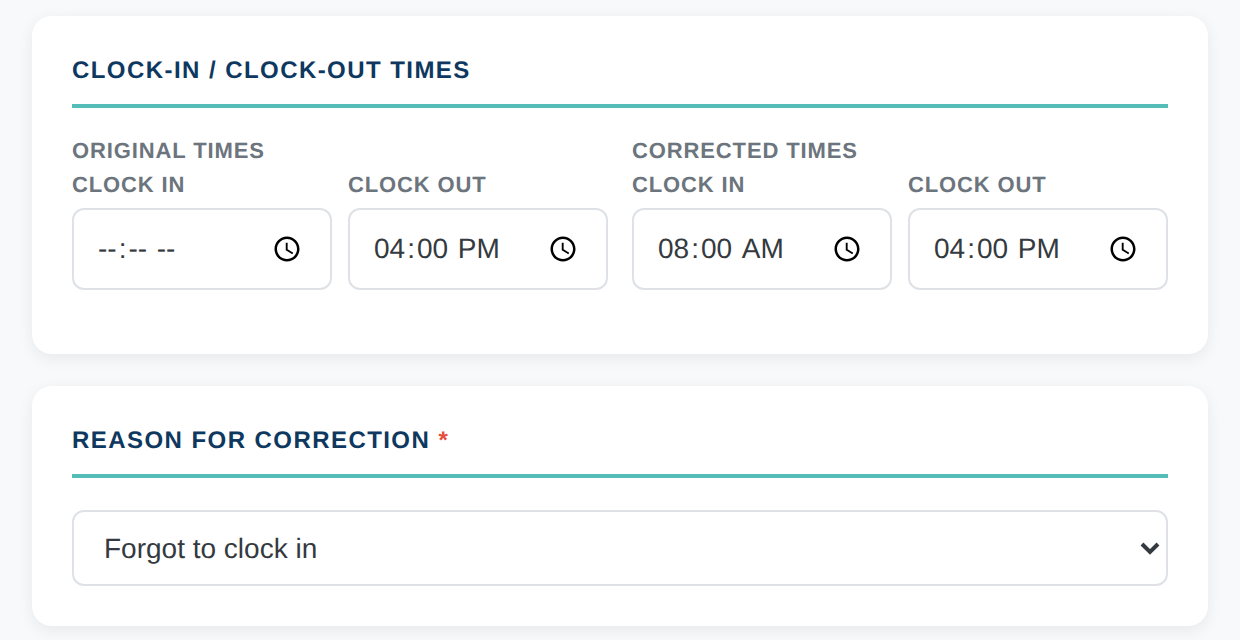
Step 2 — Times and reason
Original Times are what WellSky actually recorded; a box stays empty if a punch never happened. Corrected Times are the times your attendant really started and finished. In the example below, the clock in was missed, so the original clock in is blank and the corrected times show the true 8:00 AM to 4:00 PM shift. The reason must honestly match what happened. Before you sign, check that the corrected times match what you saw: when your attendant arrived and when they left.
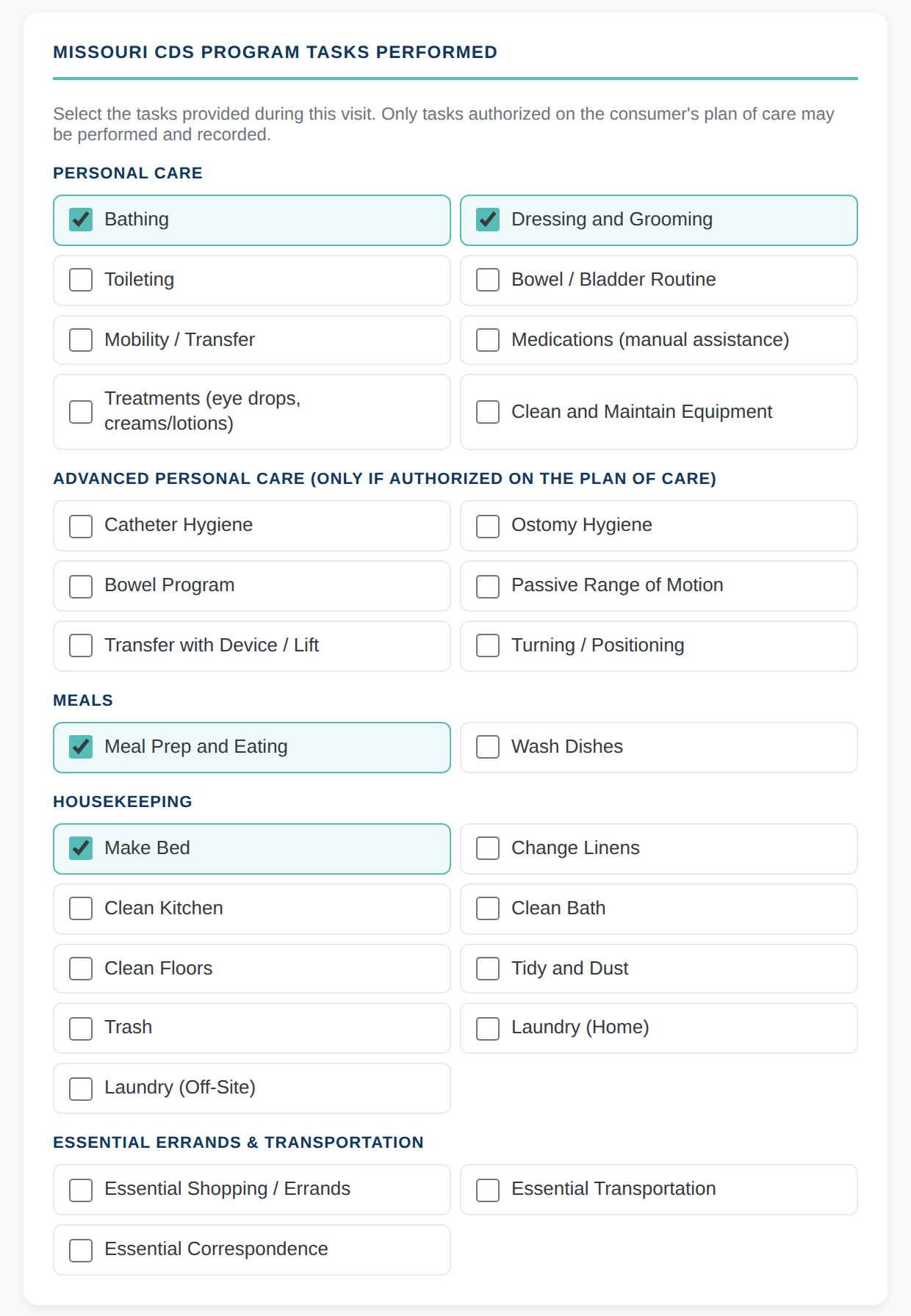
Step 3 — Tasks performed
Only the tasks actually performed during this visit get checked, and only tasks on your plan of care. If a task is checked that was not done, do not sign until it is fixed.
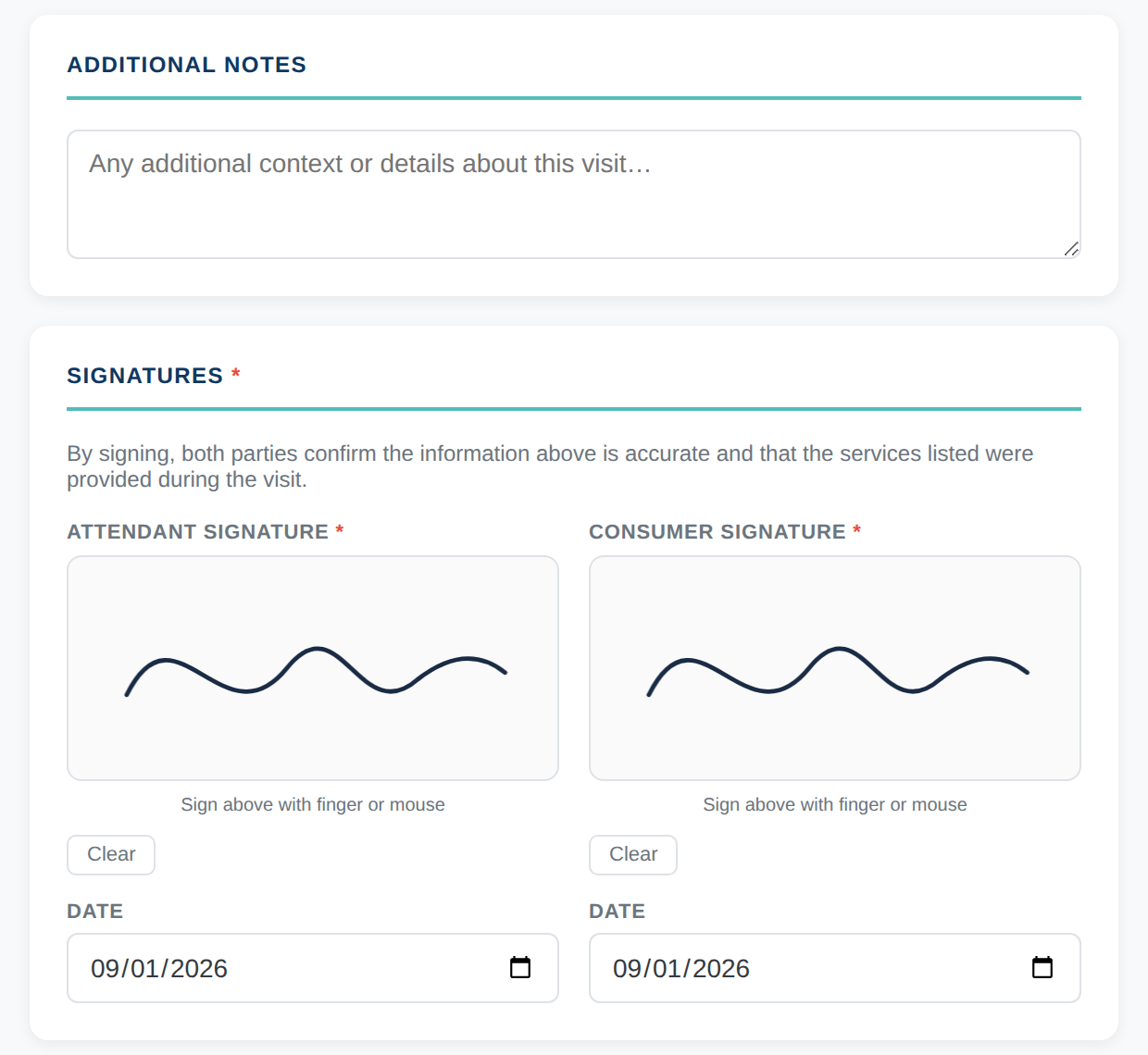
Step 4 — Sign together and submit
You and your attendant each sign with a finger or mouse and date your own signature. Your signature is your word that the services really were provided at those times, so sign together during the visit, never in advance and never for time you did not see worked. After Submit, a confirmation screen appears and the office processes the correction in WellSky. Nothing more is needed from either of you.
Remember
The goal is 95 percent or more of visits clocked correctly the first time, with no manual change from us. Missouri Medicaid treats a high rate of manual corrections as a possible fraud indicator, and every correction is reviewed individually in an audit.
So use the form when you truly need it, not as a normal way to record time. If corrections are happening most weeks, call us at {{ phone }} and we will find out what is going wrong with the app.
Your attendant's questions come through you
You are the employer. If your attendant has a question about their pay, their hours, this form, or anything else, they bring it to you, and you contact Caring Companions at {{ phone }}. We work it out with you, and you pass the answer along.
Attendants should not contact the office directly, so if yours ever does, remind them the chain runs through you. It keeps you in charge of your own care, which is the whole point of CDS.
What would you do?
Your attendant arrives at 8:00 a.m. but forgets to clock in until 9:15 a.m. What should you do?
Correct. Report it to us immediately rather than trying to correct it yourselves. Never record time that was not actually worked.
{{ fb_m6 }}
Module 7 of 8
Protecting the program
CDS is paid for by Medicaid. Protecting it protects your care, your attendant, and every other family in the program.
What Medicaid fraud looks like here
Any falsification or misrepresentation of your attendant's time worked is Medicaid fraud. Examples from our policy include:
Time submitted for days your attendant did not work
More hours submitted than were actually worked
Tasks marked that were not actually done
A timesheet filled out before the work happened, or for days that have not occurred yet
Time submitted for tasks not approved on your plan of care, such as yard work, pet care or home repair
Time submitted for days you were in the hospital, at the doctor, in rehab or in a facility
Time submitted while your attendant was working for someone else, or was in the hospital or jail
Work done by someone other than your approved attendant, submitted under their name
Signatures or initials that are not really yours or your attendant's
Stop
Never ask an attendant to clock in for care they did not actually provide, even to avoid losing hours, even if you feel they earned it another way, and even if they offer.
What happens if it occurs
Caring Companions is required to report suspected Medicaid fraud to the Missouri Medicaid Audit and Compliance Unit, DHSS, and the Missouri Attorney General. All payments made from inaccurate time are recouped from the consumer and the attendant. We may stop payments, disqualify the attendant from working for any of our consumers, and withdraw as your CDS vendor. Individuals who violate Medicaid fraud rules may lose Medicaid eligibility for life, face criminal charges, financial penalties and prison time.
We would much rather retrain than report. Mistakes reported honestly and promptly are handled very differently from concealed ones.
Never ask your attendant to
Clock in when they are not with you providing care
Do tasks that are not on your plan of care
Care for your visitors, children or pets
Sign or initial anything for you, or let someone else work under their name
Record time while you are in the hospital or a facility
Buy their own gloves, cleaning products or gas for your tasks
Knowledge check
Your authorized hours are best described as:
Correct. Authorized units are a ceiling on care that actually happens.
{{ fb_m7 }}
Module 8 of 8
Changes, safety and speaking up
Life changes. When it does, one phone call keeps your services and your attendant's pay on track.
Tell us within ten days
Any change that affects your plan of care
A change in your address, phone number or living situation
A change in your condition or your care needs
A change in your Medicaid eligibility or your spenddown
A change of attendant, or an attendant who quits
Tell us right away
You are hospitalized, or admitted to rehab or a facility
You will not be home for a scheduled shift, so your attendant knows too
A problem with the quality of your attendant's work
Any safety concern in your home
Your backup and emergency plan
Every consumer needs a backup and emergency plan, and we will help you build one. It answers a simple question: what happens if your attendant does not come and you need care today? A hired backup attendant, a phone list, and a plan for weather or power outages cover most situations.
Abuse, neglect and exploitation
You have a right to be safe and treated with dignity. Abuse can be physical, sexual or emotional. Neglect is a failure to provide needed care. Exploitation is taking control of your property or money by deception, intimidation or force, including misuse of a power of attorney, theft or forged checks.
Call us
If you are being harmed or feel unsafe, call the DHSS hotline at 800-392-0210. Every attendant is a mandated reporter and must report suspected abuse, neglect or exploitation to that same number.
For anything about your services, your attendant or your hours, call Caring Companions at {{ phone }}.
If you are not satisfied
Concerns are meant to be solved at the lowest possible level, and most are. If yours is not, the grievance process is:
Meet with the direct services staff and their immediate supervisor to talk it through
Put your concern in a letter to them. You get a response within five working days
If that does not resolve it, request a meeting with the Executive Director. It happens within ten days of your written request
If informal problem solving fails, file a written grievance with the Executive Director. You get a written response within ten workdays
You may appeal that written decision to the next level within 30 calendar days. The final decision is issued within thirty workdays
You may name someone to help you or speak for you at any point in this process. Using the grievance process never affects your services.
What would you do?
You are admitted to the hospital for three days. What should you do?
Correct. Notifying us when you are hospitalized is one of your listed responsibilities, and no time may be recorded for days you were in a facility.
{{ fb_m8 }}
Final knowledge check
Twelve questions
Answer each one. If you miss it, you will see why, and you can pick again. Nothing here is a test of your worth as a person.
Answered correctly: {{ score }} of 12
Question {{ q.num }}
{{ q.q }}
{{ q.ok }}
{{ q.fb }}
{{ ackLockMsg }}
Almost done
Orientation acknowledgment
Please check each statement, then type your name and today's date.
Typing your name here records your acknowledgment of this orientation. A Caring Companions staff witness signature is collected separately.
{{ finishLockMsg }}
✓
You are finished
Consumer CDS Orientation complete
Name{{ name }}
Date{{ date }}
Modules completed{{ doneCount }} of 8
Final check score{{ score }} of 12
Time spent{{ elapsed }}
Keep this page or print it for your records. Questions about anything you learned? Call us at {{ phone }}.